
What our experience brings to clients
BrainTrainUK is a team-based UK neurofeedback practice established in 2013.
We were the first UK practice to offer Infra-Low Frequency (ILF) neurofeedback, following our founder Stuart Black training with Siegfried and Susan Othmer in the United States in November 2012.
Our experience is organisational, not limited to one practitioner. Clients work with a named practitioner who is supported by the wider BrainTrainUK team, its accumulated knowledge, shared standards and access to experienced oversight. This provides broader perspective and greater continuity than a practice dependent on one individual.
Bringing ILF neurofeedback to the UK: 2012-2013
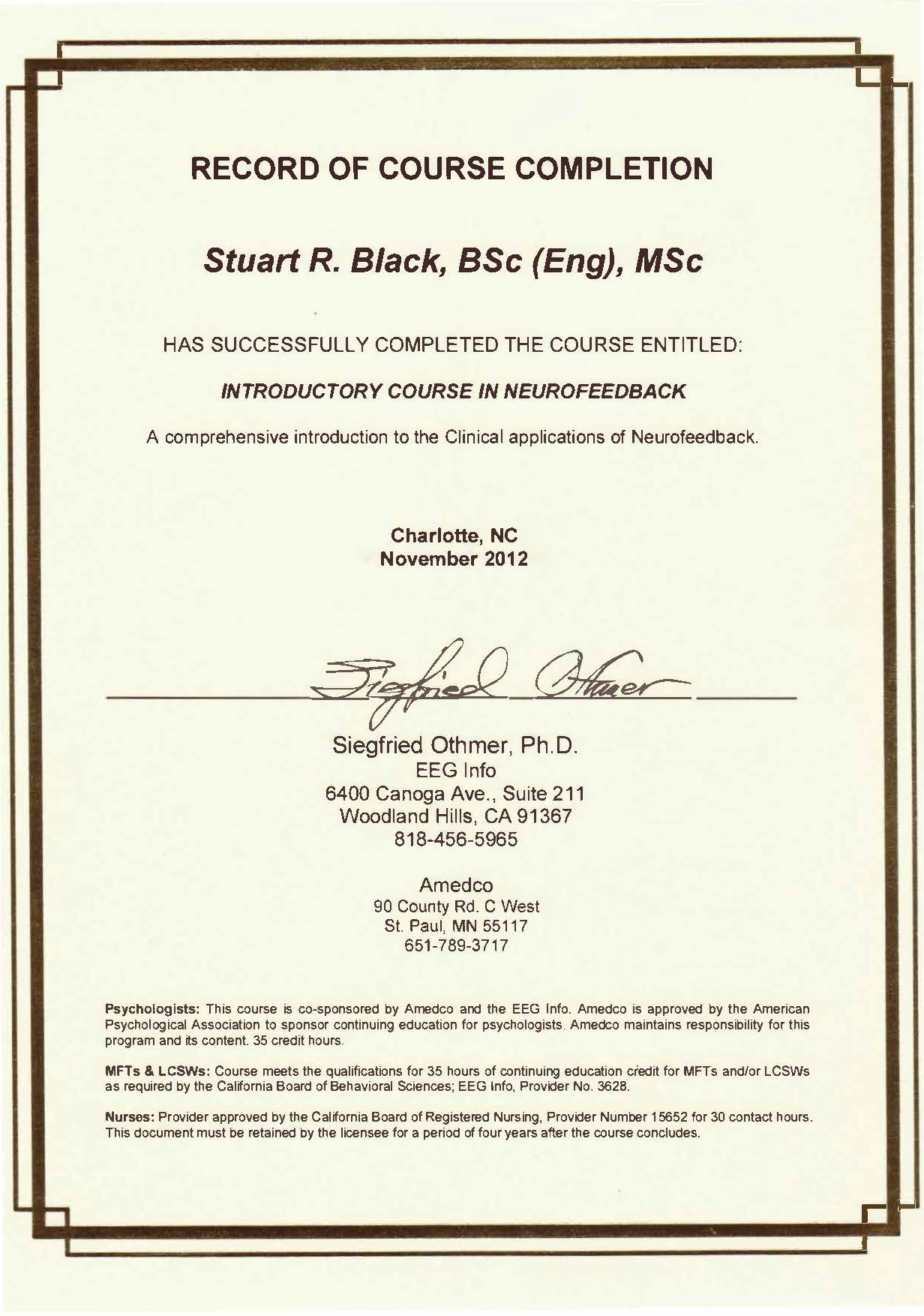
In November 2012 Stuart Black attended his first neurofeedback training course in Charlotte, North Carolina, run by Siegfried and Susan Othmer. They had recently introduced what has become known as ILF, or Infra-Low Frequency neurofeedback, and Stuart brought this expertise to the UK for the first time.
The next month, Stuart went back to the USA, this time to Woodland Hills, in the San Fernando Valley on the West side of Los Angeles, where he spent an intensive two weeks immersing himself in the way that Sue Othmer’s EEG Institute neurofeedback clinic operated, and received a programme of 20 sessions of neurofeedback.
In 2013 Charlotte Keizer joined us, she went to Los Angeles for training and in April 2013 we opened our first clinic in Egham, Surrey, offering ILF and Alpha-Theta Neurofeedback. In summer that year Zuzana Radokovska joined us, went to Los Angeles for training and began practising in Hoddesdon, Hertfordshire. In August 2013 we opened our first London clinic, in Battersea.
Building knowledge, research and technology
Since then, we have continued to invest in education. Stuart has attended every Advanced Clinical Summit in Los Angeles since 2014, often being the only attendee from Europe, where we learned about the latest developments and returned with new learning, new software and new protocols.
In between, for several years we had monthly calls with Sue Othmer or her colleagues in Los Angeles, who acted as mentors and coaches as we encountered new scenarios and sought advice from the world’s leading authorities. To this day, we make it very clear to our team that if they ever feel stuck, they should ask for help, and they are welcome to book a call with the global clinical lead at EEG Info, and charge it to the BrainTrainUK account.
We have continued this team-based approach since, recognising that it is important that clients benefit from the combined experience of not only the practitioner they see, but our wider team, and our extended network that has grown over time.
In 2013 we were the first neurofeedback practice to exhibit at the Times Education Supplement Special Educational Needs (TES SEN) show in London.
In 2014, we developed an algorithmic decision-support system that translated the 160-page protocol guide into structured rules. This helped our practitioners map client histories and symptoms to potential neurofeedback protocols when preparing Neurofeedback Plans.
In 2015 we introduced home training, enabling clients who lived too far away or who were very time poor to access the same services they received in the clinic, in their homes, and hours that suited their schedule, not ours.
In 2017 we committed to the steep learning curve to master Dr David Kaiser’s unique approach to QEEG analysis and reporting, and were the first outside the Americas to offer the Kaiser Neuromap service, which we renamed Advanced QEEG Brain Mapping. We added traditional EEG-band amplitude to our range of neurofeedback modalities, along with ILF, Alpha-Theta and Synchrony.
Bessel van der Kolk’s 2015 book “The Body Keeps the Score” had a profound impact on the awareness of neurofeedback within the trauma community. A whole chapter advocating for neurofeedback led to renewed interest from many people for whom the existing paradigms of mental health had not been helpful.
In 2019 we became industrial sponsors for Marcia Saul’s doctorate at the University of Bournemouth, for which Stuart wrote the Research Questions. As part of this work, Stuart co-authored the peer-reviewed 2022 paper “A Two-Person Neuroscience Approach for Social Anxiety: A Paradigm with Interbrain Synchrony and Neurofeedback”, published in Frontiers in Psychology.
Stuart is currently undertaking a part-time PhD in Psychology at the University of Bath, supervised by Dr Neal Hinvest. His doctoral research is focused on the theory and application of inter-brain synchrony in human interaction. His particular interest is whether real-time feedback derived from the simultaneous recording of brain activity from two or more people could be used to enhance synchrony and interpersonal connection.
Experience with trauma and developmental adversity
In 2017 a friend of Stuart and his now-wife, Inta, tragically passed away suddenly, leaving three children behind. Stuart and Inta were looking after them at the time, and they stayed with them when it became clear there was no-one else able to step forward. This involved 17 months, 11 trips to court, eight in the High Court, and a steep learning curve in the world of childhood trauma, the care system, fostering and kinship care, before Stuart and Inta became their Special Guardians.
The following year, Stuart met Sairah Shah, Deputy Head Teacher at Surrey County Council’s Virtual School, at a foster carers support meeting. Sairah persuaded Surrey County Council to commission a pilot study for five looked-after children. The results became the basis of our report exploring the use of applied neuroscience, including QEEG analysis and neurofeedback, with children and adults affected by developmental trauma, which includes a comprehensive analysis of the health economics of unremediated childhood trauma and how neurofeedback compares to other therapies approved by the NHS.
In 2019 Stuart and Sairah presented the results of the pilot at the TES SEN Show.
This report became the basis of Stuart’s book, “Neurofeedback for Trauma: Past, Present and Future – How to Add Neurofeedback to your Service”, which he launched at the Action Trauma Conference in Belfast in 2022, and presented to Bessel van der Kolk after he came off stage for his keynote talk.
Subsequently, Stuart has dedicated voluntary time to helping other families in a similar position, becoming a Trustee of national charity Family Rights Group in 2019, in 2022 Inta and Stuart founded a new charity, The Family Support Group, which joined the Kinship Care Alliance, involved in lobbying government on reform of support for kinship families.
In December 2025 Stuart was interviewed for the Mastering Change podcast from the organisers of the world’s largest trauma conference, Transform Trauma Oxford.
How we develop and support our team
By 2023 we had taken our training in-house. We’ve all sat for days at a time listening to PowerPoint-based lectures – the truth is these teaching methods are “easier” to deliver but harder to learn from.
We can offer the small group, intensive, learning experience that you get with Oxford’s tutorials (Cambridge calls them supervisions). Our practical teaching provides the intense feedback from working with real clients that you cannot get in a classroom. We integrate the “grand rounds” approach used in medical schools by taking trainees through real, live client scenarios to give early immersion into our clinical culture, experience of real-world clinical reasoning and exposure to professional role modelling.
Through our differentiated style of teaching and learning, we develop practitioners capable of critical and independent thinking, well-equipped to face the challenges of a field such as neurofeedback, and provide a foundation for their future learning journey.
We don’t just teach the dogma of one particular school of neurofeedback – we educate on the range of approaches that exist, and why we offer what we offer.
Our team have access to our extensive knowledge base collected, cultivated and curated over years to give access to the best knowledge in the field, integrated into our own, proprietary, AI Agent in 2026. This provides our team with clinical-decision support, but it does not autonomously make treatment decisions.
Collective experience and continuity
As a team-based practice, clients get several benefits over a single practitioner practice. Clients get access to our collective knowledge, wide experience, shared standards, methodology and organisational learning accumulated since 2013.
A team model also provides resilience and continuity. If a practitioner is unavailable, another suitably experienced team member can provide cover where appropriate, with a proper handover and the client’s agreement. The practice is therefore not wholly dependent upon the availability of one individual.
Growth across the UK
In 2013 we opened a weekly clinic in Harley Street; in 2021 we moved our full-time clinic from Battersea to the West End.
In 2016 we opened in Crawley, West Sussex, led by Anna Dybul, who originally trained in 2013.
In 2017 we opened in Harrogate, Ripon and York, led by Kirsten Antoncich, a highly experienced therapist and now an academic at Birmingham University. Our Yorkshire practice was suspended in 2022 after Russia invaded Ukraine and Kirsten bravely joined a UNICEF project to support Ukrainian children affected by the trauma of war.
In 2020, we opened in Farnborough, Hampshire.
In 2022, we opened in Birmingham.
In 2025, we opened in Essex.